

What is Algorithmic Trading?
Before we get into the exciting world of algorithmic trading, let's go on a fascinating trip back in time. Imagine the stock market floor as a wild symphony of traders shouting bids and offers, desperately trying to get the best deals. In the early days of trading, people used their instincts and maths to make decisions. This was exciting, but it also meant that people could make mistakes and be influenced by their emotions. Then, the digital revolution change brought about the age of algorithmic trading.
What is algorithmic trading, then? Imagine a group of computer programs working together to carefully make trades based on rules and mathematical models that have already been set. These programs use and process a lot of market info most efficiently, leaving little room for mistakes. Algorithmic trading is the art of making trade decisions automatically using the language of numbers and patterns to act quickly and correctly on chances. Algorithmic trading software are the best example of financial automation because it is no longer limited by what people can do.
In this article, we will demystify the concept of algorithmic trading, breaking it down into simple terms for beginners and providing valuable insights for those looking to sharpen their skills. We will talk about everything you need to know to get started in the exciting world of algorithmic trading, from the basics to the techniques, the tools, to the way you think.
See what markets are pricing in
Live indices, sector moves and market breadth — the backdrop to every story we publish.
Getting Started with Algorithmic Trading
Getting started with automated trading is both fun and challenging. Going into it with a good plan and knowledge of how financial markets work is essential.
To get started, you need to learn about things like fundamental analysis and technical analysis, as well as trading jargon like "short," "long," "stop loss," "take profit," and so on. One also needs to grasp mathematics and statistical concepts like mean, standard deviation, correlation, etc. Languages like Python, R, or C++ for writing code. Python is often used for algorithmic trading because it has many libraries for data analysis, backtesting, and automating trade. When you know all of this, you'll be in a good position to start making your own trade algorithms.
You can start by getting the real-time and historical data you'll need to implement your strategy and test it. There are many places to find info, such as Yahoo Finance, the Reserve Bank of India, Bloomberg, etc.
Now that you have the correct data set, you can start making algorithms that include your trade logic. Most trading methods have conditions for when to enter, trade, and leave. It could be a simple moving average crossover strategy or a more complicated algorithm with much math, like machine learning methods.
How Does Algorithmic Trading Work?
Algorithms make it possible to make trades based on thorough data analysis and respond quickly to price changes. It builds models that help us trade using mathematical and statistical methods. The algorithmic trading method is mostly made up of three steps.
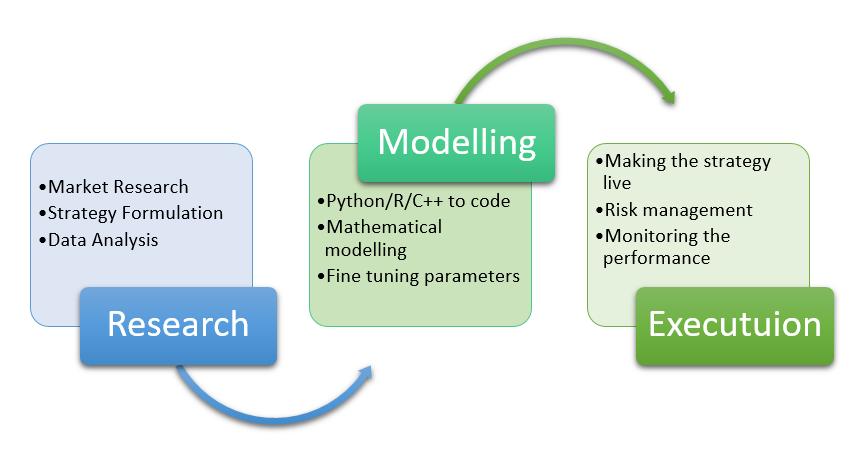 1. Research and Strategy Formulation
This includes doing the initial study and coming up with a plan. Traders work to gather information like past prices, essential ratios, news sentiment, and articles about a particular stock or portfolio. They use this information to come up with trading ideas.
Market research is carried out first to explore potential inefficiencies in the market. It involves analysing historical data, macroeconomic indicators and other relevant market analysis.
This leads to formulation of trading algorithms. Traders will make mathematical models and set rules for when to enter and leave a trade. Strategies can be based solely on statistics and technical indicators or a mix of Machine Learning and fundamental analysis.
2. Modelling and Optimization
Once a trading strategy is developed, it can be put into a computer program using languages like Python, R, etc. Python is the most popular choice among traders because it is easy to use and has a lot of tools. The approach can be based on simple regression models, advanced machine learning techniques, or time series. It depends on how complicated the strategy is. Backtesting is done to understand the power of logic after the plan is implemented. Optimization tools are used to fine-tune strategy parameters so that returns are maximized, and risks are kept to a minimum.
3. Execution and Implementation
Once the algorithms have been created and optimized, they can be used in the market. Risk management is the most critical part of any trading plan that wants to minimize losses. For a trading system to be profitable and reliable over the long term, it needs good risk management. Typical parts of risk management are stock size, stop loss limits, etc. Visit our blog to learn how we manage risk at Wright Research.
After putting a solid risk management plan in place, the next important step is to monitoring your trades. It checks to see if the algorithms are working as predicted and try to figure out how the market works so that changes can be made in the future. Read our article on What are the different types of Algo Trading?
Examples of Algorithmic Trading
There are many ways to trade using algorithms. Here are just a few examples:
- Asset A usually moves before asset B. We can buy or sell A based on behaviour of asset B.
- Make a trading signal based on news about a particular asset.
- A group of stocks within a sector usually move together. One stock moved in unusual direction. So, we can buy or sell this stock in hope that it will revert to normal.
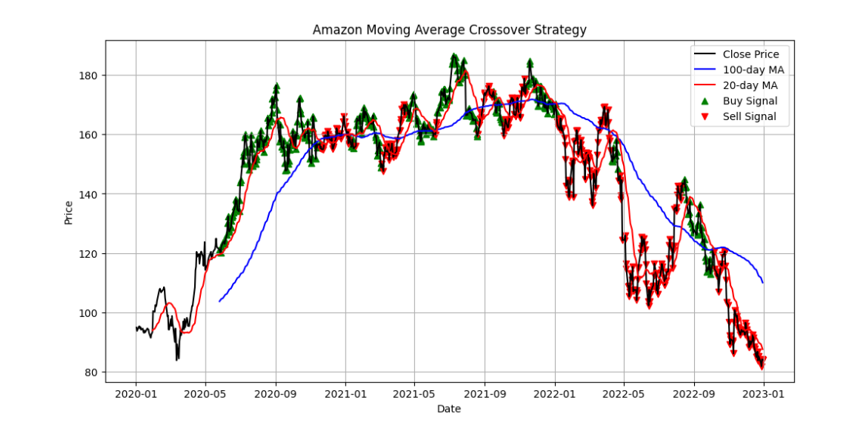
Let’s take a closer look at a simple strategy using python. It is called the Moving Average Crossover Strategy. Let’s take a stock of Amazon. We build a simple trading strategy based on short term and long-term moving averages crossover.
In this example we calculated 20-day MA and 100-day MA for amazon stock. The signals are generated using following logic:
20-Day MA > 100-day MA: Signal Buy
20-Day MA < 100-day MA: Signal Sell
Many algorithmic trading techniques exist, like Momentum , Mean-Reversion, and Pairs Trading. Visit our blog for an extensive guide on trading pairs with Python.
Why Python Is the Language of Choice for Algo Trading
Python makes numerical experiments relatively easy to read and revise. pandas handles dated observations, NumPy supports array calculations, and plotting libraries help reveal gaps or unusual behaviour. That combination makes algorithmic trading with Python accessible without requiring developers to build every component themselves.
Learning python for algo trading also connects research with software engineering. The same functions can support notebooks, tests and scheduled jobs. An algorithmic trading Python project should begin with one instrument and a clearly defined question. More securities and complex models can wait until the basic logic is reliable.
Benefits of using Python for algorithmic trading
Using Python, the above example can be coded in minutes. So, let's consider why Python is the best choice for algorithmic trading. Python is becoming more and more famous these days. Since it has access to many integrated APIs and functions, it is the best choice for algorithmic trading. Some of the most important reasons to use Python are:
- Python is easy to learn because its syntax is similar to simple English.
- It has many libraries, like NumPy, pandas, and matplotlib, that are good for analyzing financial data and making trading plans.
- It has a lot of quantitative finance tools, like PyFolio, Zipline, and Quantlib. These make it easier to test the past and manage risk.
- Python's Machine Learning and AI tools, such as scikit-learn, PyTorch, and TensorFlow, work well together. Making itself the first choice of more skilled coders.
- It works well with big data tools like Apache Spark, which makes it easy for traders to handle a lot of financial data.
- Python algorithms can be used for trading with low latency on cloud platforms, dedicated computers, and even microcontrollers.
So, Python is undoubtedly the best way to start with algorithmic trading.
Benefits of Algorithmic Trading
We all now know what algorithmic trading is and how it works. It has a lot of benefits, which is the main reason why it is so prevalent in the market. Here are some of the good things about it.
- It eliminates the possibilities of human errors such as entering incorrect details or missing trade opportunities. Hence it makes trading faster and efficient.
- It eliminates emotional bias and makes choices solely based on data and rules.
- It lowers the need for manpower and manual checking, saving money.
- It can handle many trades and manage various portfolios at once.
- Algorithms can be fully backtested using historical data to see how well they work in different market conditions. So, it makes it possible to optimize the logic correctly.
Read our article on Best Algo Trading Platforms in India: Our Recommendations
Core Advantages of Using Python for Algorithmic Strategies
The main advantage of algorithmic trading with Python is repeatability. Given the same data, parameters and software versions, a deterministic strategy should produce the same signals. This makes mistakes easier to investigate and competing ideas easier to compare.
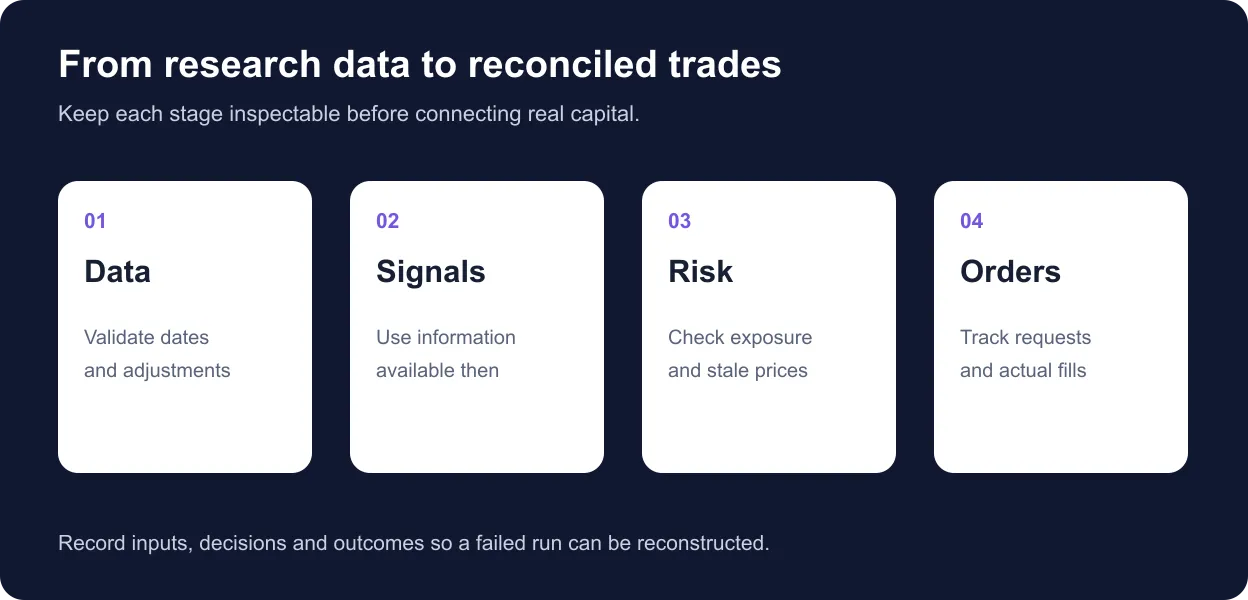
Using python for algo trading can reduce repetitive manual work, but human errors can become software errors. Wrong units, stale prices or an incorrect symbol can affect every order. Good python trading systems therefore separate data preparation, signal generation, risk checks and execution. When coding trading rules, make each stage independently observable.
Setting Up Your Python Trading Environment
Install a supported Python release and create an isolated virtual environment. Start with pandas, NumPy and a plotting package. Save the tested package versions and keep your code under version control. The official Python documentation explains how virtual environments keep project dependencies separate.
For python for algo trading, organise folders for immutable raw data, cleaned datasets, notebooks, reusable functions and test results. Store API credentials outside source files. An algorithmic trading Python environment also needs consistent timestamps, exchange calendars and checks for missing observations.
| Component | Purpose | First check |
|---|---|---|
| Python and virtual environment | Reproducible execution | Record interpreter and package versions |
| pandas and NumPy | Time series and numerical work | Validate dates, values and missing data |
| Matplotlib | Inspect prices and signals | Label units and observation periods |
| Broker SDK | Authenticated data and order access | Confirm current permissions and documentation |
| Logs and tests | Trace behaviour and failures | Reproduce a signal from saved inputs |
Treat data quality as part of algorithmic trading with Python. Confirm adjustment conventions for splits and dividends, licensing rights and whether historical constituents include delisted companies. A convenient free dataset is not automatically suitable for execution research.
Get research like this in your inbox
The week’s research that mattered, in five minutes. Joined by 2L+ investors.
Building Blocks: Trading Concepts You Must Know First
Before using python for algo trading, understand bid and ask prices, spreads, liquidity, order types and position sizing. A market order prioritises execution but does not fix the price. A limit order controls the acceptable price but might remain unfilled.
Your python trading model must distinguish a signal, an order and a completed trade. They are different events. Decide whether the strategy is long-only, when it evaluates information, and which session permits execution. When coding trading conditions, specify holidays, rejected orders and incomplete bars rather than assuming every timestamp is tradable.
An algorithmic trading Python specification should state its universe, entry condition, exit condition, capital allocation and maximum exposure. Without those definitions, different implementations can produce different results while appearing to follow the same idea.
Writing and Testing Your First Trading Strategy
Start algorithmic trading with Python with a transparent moving-average rule. Calculate a 20-session average and a 100-session average from completed daily closing observations. Hold a long target when the shorter average exceeds the longer one; otherwise target cash. These windows are teaching choices, not optimised recommendations.
The following python trading example generates desired positions for the next session. It assumes a cleaned, chronologically indexed pandas DataFrame named prices, with a numeric close column. There is no broker connection and no claim about returns.
import pandas as pd

def next_session_target(prices: pd.DataFrame) -> pd.Series:
    close = prices["close"].sort_index()
    if close.index.has_duplicates or close.isna().any():
        raise ValueError("Use unique dates and complete prices")
    fast = close.rolling(20, min_periods=20).mean()
    slow = close.rolling(100, min_periods=100).mean()
    target = (fast > slow).astype(int)
    target = target.where(slow.notna(), 0)
    return target.shift(1, fill_value=0)
For python for algo trading, timing is essential: today's closing price becomes available only after that bar completes. Shifting the target prevents using that information earlier in the same session. An algorithmic trading Python backtest must still specify the next executable price, order latency and transaction costs.
Test a rising series, a falling series, a flat series and insufficient history. When coding trading signals, verify that unchanged target holdings do not generate repeated purchases. Compare the target with actual holdings before creating an order for the difference.
Backtesting: Validating Your Strategy Before Going Live
Backtesting algorithmic trading with Python asks what a precisely defined process would have done under stated assumptions. Include brokerage, applicable taxes and levies, spread, slippage and market impact. Apply the schedule relevant to the instrument and period instead of assuming one universal trading cost.
For python for algo trading, split observations chronologically into development, validation and untouched test periods. Repeatedly changing parameters after seeing the test results turns the test into training data. An algorithmic trading Python study should record every experiment, including unsuccessful ones, to expose selection bias.
Review drawdowns, turnover, exposure and performance across different conditions. A python trading report that shows only cumulative profit conceals how much risk or capital was required. When coding trading simulations, model delayed fills and missing data, and compare results with a relevant passive benchmark.
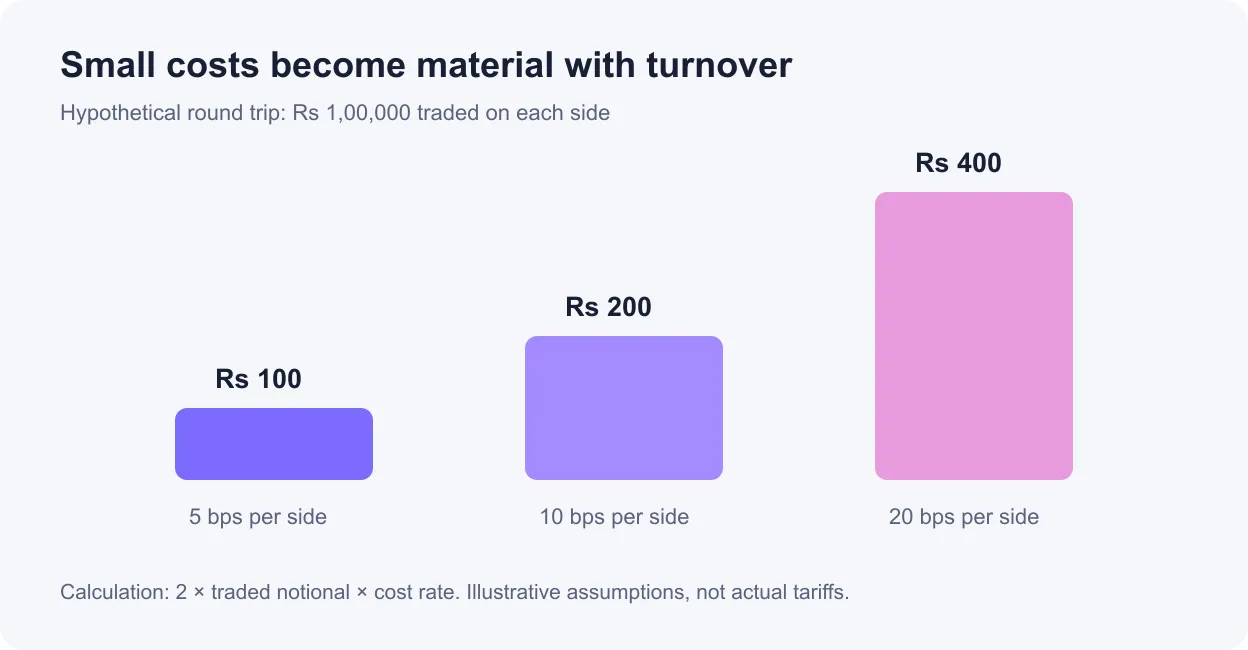
Consider a hypothetical ₹1,00,000 traded notional on each side of one round trip. If the combined cost assumption is 5 basis points per side, the total is ₹100. At 10 and 20 basis points per side, it becomes ₹200 and ₹400. These are sensitivity assumptions, not broker tariffs or observed investment results.
Finally, paper trading tests operational behaviour with current data. It can reveal scheduling and reconciliation problems, but simulated fills still cannot establish the liquidity available to real orders. Robust algorithmic trading with Python requires both research discipline and operational testing.
Connecting Your Strategy to a Broker API
Choose a broker-supported integration and read its current authentication, order and data documentation. Using python for algo trading through an API requires session management, rate-limit handling and a record of every request. Never assume an acknowledged request is a completed trade: Kite Connect explicitly distinguishes placement from execution.
An algorithmic trading Python execution service should handle pending, partially filled, cancelled and rejected orders. After a timeout, reconcile order history before retrying; a blind retry can create duplicate exposure. Keep strategy identifiers, broker order identifiers and actual fills linked in persistent logs.
The Indian retail-algo framework
SEBI's September 2025 circular set 1 April 2026 for application of the retail-algo framework to all stock brokers. NSE's November 2025 FAQ says API orders require algo tagging, including standardised tagging within the 10-orders-per-second threshold. It also identifies static-IP requirements for tech-savvy investors using their own API setup. Confirm the current onboarding and registration route with your broker before activation.
For algorithmic trading with Python, low order frequency does not remove all obligations. NSE's FAQ also prohibits algo market orders and identifies additional IOC restrictions in commodities. When coding trading execution, confirm permitted order types with the broker rather than treating API availability as unrestricted permission.
Managing Risk in Algorithmic Trading
Set risk limits before running python for algo trading with capital. Limit order size, instrument exposure, aggregate exposure and acceptable losses. Reject orders when prices are stale, data is incomplete or the proposed trade breaches available funds. Stops can help control exposure but cannot guarantee an exit price during gaps or illiquidity.
An algorithmic trading Python system needs a deliberate stop procedure: prevent new orders, inspect working orders and reconcile positions. Define who receives alerts and how recovery happens after an outage. Restarting software should not erase knowledge of positions already held at the broker.
When coding trading risk controls, test failure cases alongside normal cases. Disconnect the feed in a simulation, reject an order and restart the process. The resulting python trading logs should explain what happened. Wright Research's discussion of risk management provides additional portfolio context.
Advanced Techniques: Machine Learning, HFT and Sentiment Analysis
Machine learning can examine nonlinear relationships, but it increases opportunities for leakage and overfitting. Use time-ordered evaluation and ensure every feature was available when a prediction would have been made. Sentiment datasets need original publication timestamps, not later edited text presented as historical information.
Using python for algo trading does not automatically provide high-frequency execution. HFT depends on specialised infrastructure, connectivity and tightly controlled latency. Python may support research while other components handle demanding execution. An algorithmic trading Python prototype should not be labelled production-ready because a notebook runs quickly.
Start advanced work only when a simple baseline is understood. When coding trading models, require evidence that extra complexity improves results after costs on unseen data. A more elaborate model can otherwise amplify a data problem rather than solve it.
Best Resources to Learn Algo Trading with Python
Build skills in order: Python fundamentals, time-series manipulation, market mechanics, backtesting and broker integration. The official Python tutorial, pandas documentation and scikit-learn's time-series validation guidance are useful technical starting points. Broker documentation should govern the exact order interface you implement.
For structured study of algorithmic trading with Python , review Wright Research's quantitative developer curriculum and confirm current course availability. Practise python for algo trading through small, documented projects before adding instruments or automation. For coding trading projects, a reproducible notebook, clear assumptions and failure tests are more useful than an impressive but unexplained return chart.
Conclusion
This piece gave us a general idea of algorithmic trading and how it works. We also looked at how Python is used in algorithmic trading today. To sum up, algorithmic trading allows traders to automate their trading activities and take advantage of technological advances to make more informed and efficient trades. Traders can make their approach fit their wants and goals by choosing different strategies. However, its crucial to carefully plan, backtest and monitor these strategies to ensure their effectiveness and manage risks.
Track the factors behind this research
Momentum, value, quality and low-vol — updated factor performance for Indian markets.
FAQ
What is algorithmic trading with Python?
It is the use of Python programs to analyse data and apply predefined trading rules. A complete system also needs risk controls, execution handling and monitoring. Research code alone is not a live trading system.
Is Python good for algo trading?
Yes. Its readable syntax and data-analysis ecosystem suit research, testing and many automated workflows. Execution requirements determine whether Python alone is appropriate, particularly where very low latency matters.
Do I need coding experience to start algorithmic trading?
You can begin learning without previous experience, but should understand variables, functions, data structures, exceptions and tests before automating orders. Learn market mechanics alongside programming and practise with research examples first.
Which Python libraries are used for algorithmic trading?
pandas supports time-series preparation, NumPy numerical calculations, Matplotlib visual inspection and scikit-learn statistical learning. A broker's supported SDK can provide authenticated connectivity. Package choice does not establish strategy quality.
Is algorithmic trading legal in India?
Yes, subject to applicable SEBI, exchange and broker requirements. Retail users should confirm their authorised API route, tagging, authentication, static-IP and registration obligations with their broker before using a live strategy.